


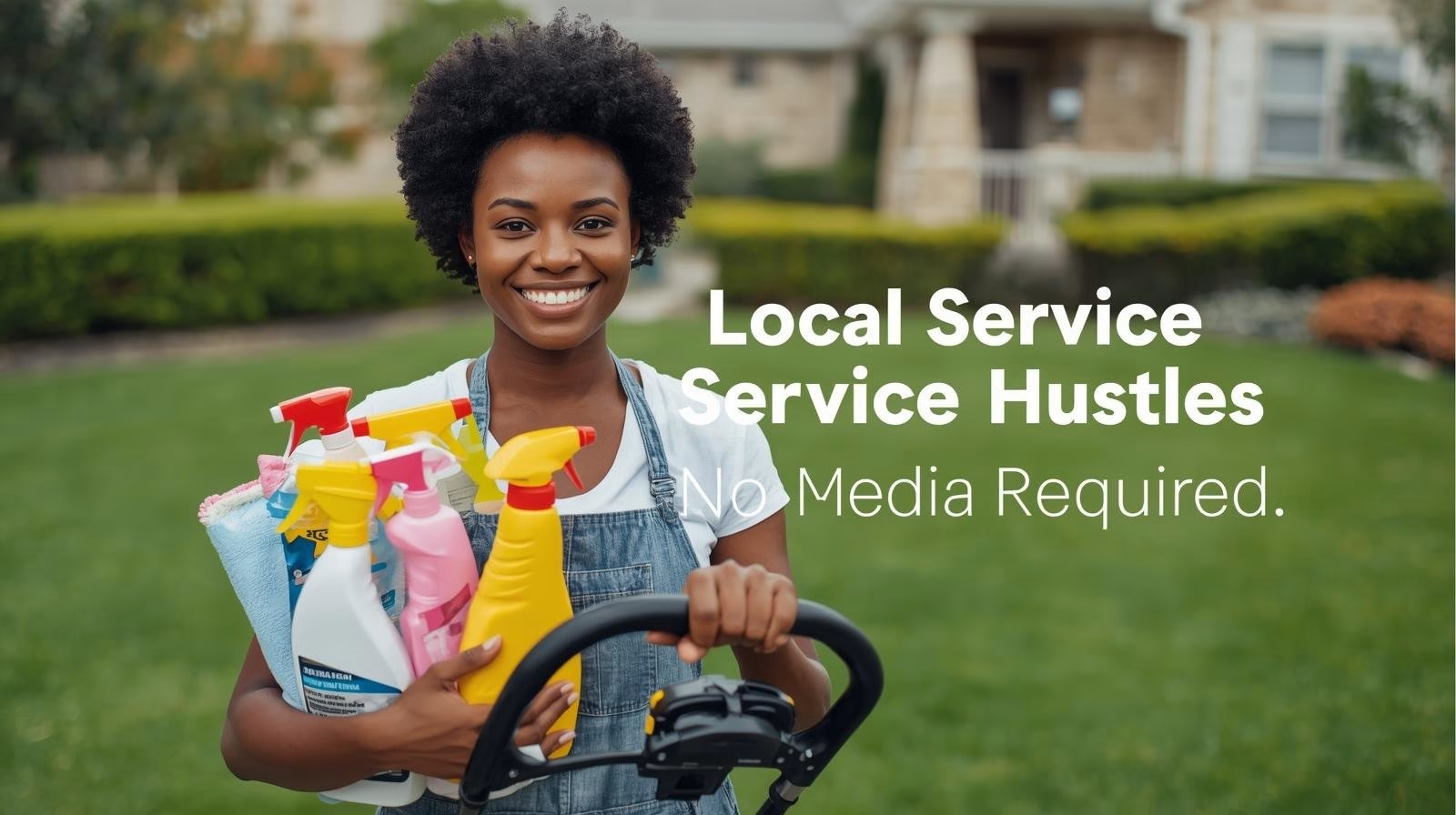
Local service hustles are among the most overlooked income opportunities precisely because they look unglamorous. There's no product to build, no audience to grow, no content calendar to maintain. A person with a lawn mower, a cleaning kit, or a set of hand tools can have paying clients within a week using channels that have existed for decades: word of mouth, neighborhood apps, and a Google Business Profile listing. No Instagram following required. No TikTok presence necessary. These are not passive income streams — they are active, physical, and dependable, and they are available to anyone willing to show up reliably and do good work.
This category of work — local service hustles like lawn care, house cleaning, pressure washing, gutter cleaning, and handyman work — has specific structural advantages over online and digital side income. The competition is local, not global. Customers search by zip code, not by follower count. Reviews on Nextdoor and Google Maps drive calls more reliably than any content strategy. And the underlying demand is consistent: grass grows, houses get dirty, gutters fill, things break. None of that changes because the economy shifts or an algorithm update rolls out.
Why Local Service Hustles Don't Need Social Media
The discovery mechanism for local services is fundamentally different from online products or digital services. A homeowner who needs their gutters cleaned is not browsing Instagram for inspiration or watching TikTok videos about gutter cleaning. They're typing "gutter cleaning near me" into Google, asking their neighborhood Facebook group, or calling a number from a door hanger on their mailbox. Understanding this is the single most important strategic insight for anyone starting a local service business: you don't need to build an audience, you need to be findable at the moment of intent.
The channels that generate local service clients:
Google Business Profile — A free listing that appears in local search results and on Google Maps. A complete profile with photos, service area, business hours, and accumulated reviews from real customers is the most effective discovery tool available to a solo local service operator. It requires setup time once and minimal ongoing maintenance. This is the single most important thing a new local service provider can set up on day one.
How the Google Business Profile algorithm actually works matters here. Google's local ranking algorithm weighs three primary factors: relevance (how well your profile matches what someone searched for), distance (proximity of your listed service area to the searcher), and prominence (how established and reputable Google perceives your business to be). Prominence is driven heavily by the number and quality of your reviews, the consistency of your business name and contact information across the web, and the activity level of your profile — photos added, questions answered, posts made. A profile with 15 genuine five-star reviews and complete service descriptions will outrank a profile with 3 reviews and a bare-bones setup, even if the second business has been operating longer. This means early review collection is not just helpful — it is the core mechanism that makes organic local discovery work. Every time you ask a satisfied client for a Google review, you are directly improving your ranking for searches like "lawn care [your city]" or "house cleaning near me." Profile photos also matter: Google's algorithm favors active profiles, and adding new photos of your work periodically signals that the business is active and real.
Nextdoor — A hyperlocal social platform organized by neighborhood. When someone on Nextdoor asks "does anyone know a reliable lawn care person?", a recommendation from a satisfied customer generates more trust than any advertisement. A single Nextdoor mention from a happy client can produce three to five new inquiries. Unlike general social media, Nextdoor is organized by verified residential location — which means every person who sees that recommendation is a potential local customer, not a random follower from another market.
Angi and Thumbtack — Lead-generation platforms where homeowners post jobs and service providers respond. These generate leads quickly at the cost of per-lead fees or subscription costs. Most established local operators use them to acquire initial clients and then move to Google and word of mouth as their primary channels once reviews accumulate. Think of lead platforms as a paid customer acquisition channel for months one through three, not a permanent business model.
Yard signs and door hangers — Still effective in residential neighborhoods for exterior services like lawn care, window cleaning, and pressure washing. A 50-home door hanger distribution costs $50 to $150 to print and a few hours to place. Conversion rates are low but so is the cost — one client covers the entire run. Yard signs placed at properties where you're actively working are particularly powerful: neighbors see the service being performed in real time, which builds more trust than any piece of paper.
Word of mouth — The dominant driver for any established local service business. One satisfied client who mentions you to two neighbors generates more reliable business than any paid marketing. It compounds: the referred clients refer others. Word of mouth also tends to produce higher-quality clients because the referral itself functions as a trust endorsement.
None of these channels require building a content library, scheduling posts, or growing a following. They require a phone number, a clear service description, and delivering on what you promise.
Lawn Care and Yard Maintenance

Lawn care is one of the most accessible local service hustles because equipment requirements are moderate, demand is predictable across residential neighborhoods, and the barrier to entry for a basic mowing operation is relatively low compared to trades that require specialized licensing.
A basic setup for small-to-medium residential yards: a self-propelled push mower or entry-level walk-behind, a string trimmer, a leaf blower, and basic transport (a truck or trailer). Used equipment in good condition is widely available. New residential-grade equipment in this range can be assembled for $800 to $2,000 depending on choices; confirm current equipment prices at retailers before purchasing, as these fluctuate with supply.
Income potential: A solo operator running a tight residential route in peak growing season — mowing five to eight properties per day, five days per week — can generate $800 to $2,000+ in gross revenue per week, depending on average job size and market pricing. At the high end, operators in affluent suburban markets with larger lots and premium service expectations can push past $2,500 per week. These figures are gross, not net — fuel, equipment maintenance, insurance, and any platform fees come out before take-home pay. Solo operators who add higher-margin services (aeration, overseeding, mulching, seasonal cleanups) to their mowing routes consistently report better margins than those running mowing-only operations, because the additional services carry higher hourly rates and use equipment already on site.
Pricing for residential lawn care varies significantly by market. Service platforms including Angi have published data suggesting average lawn mowing costs for a standard residential yard fall in the $50 to $175+ range per service, with the wide spread driven by yard size, regional labor markets, and local competition. Verify pricing in your specific market by researching what competitors charge locally before setting your own rates.
The highest-value clients in lawn care are those who sign maintenance contracts: weekly or bi-weekly service throughout the growing season at a fixed monthly rate. These clients create predictable cash flow, reduce the time spent on scheduling and invoicing, and provide a base load of revenue on which to build the rest of the schedule.
Higher-margin add-on services within the same category: seasonal cleanup (spring and fall leaf and debris removal), hedge and shrub trimming, aeration and overseeding, mulching and bed edging. Operators who bundle these into seasonal contracts consistently earn higher average revenue per client than those running one-off mowing jobs.
Insurance and licensing: Licensing requirements for lawn care vary by state and municipality — most residential mowing does not require a contractor's license, but applying certain pesticides or fertilizers does require a state pesticide applicator's license in most jurisdictions. Check your state's requirements before offering chemical lawn treatments. General liability insurance is important for all operators: dropping a stone through a window, damaging an irrigation head, or causing property damage while working generates liability that a basic GL policy covers. A GL policy for a solo lawn care operator typically costs $400 to $800 per year depending on coverage limits and location; confirm current rates with a commercial insurance agent. Some clients, particularly property managers and HOAs, require proof of insurance before awarding work — having it in place before you need it is worth the cost.
House Cleaning
House cleaning has the lowest startup cost of the local service hustles in this article. The equipment needed — microfiber cloths, multi-surface cleaners, a vacuum, a mop, and basic supplies — costs $100 to $300 to assemble. Some clients prefer to provide their own supplies, further reducing the operator's overhead. The main business asset is reliability and thoroughness, which is what drives repeat bookings and referrals.
Income potential: Residential cleaning pricing varies by market. Data from service platforms suggests standard cleaning for a 2-to-3-bedroom home typically runs $100 to $250+ per visit for a solo cleaner, with recurring clients often at the lower end of the range as a retention incentive. A cleaner handling four to five standard homes per day on recurring biweekly or weekly schedules can generate $400 to $900+ in daily gross revenue in a productive market. Deep cleaning, move-in/move-out cleaning, and post-construction cleaning command higher rates — often 1.5 to 2 times the standard cleaning rate — because they require significantly more time and physical effort. Verify current market rates locally before pricing, as cleaning rates are highly regional.
The income model that produces the most stability: a base of recurring biweekly or monthly clients. A cleaner running eight to ten biweekly recurring clients has a predictable schedule, minimal new client acquisition effort, and a reliable monthly income floor. Initial clients typically come from Nextdoor, personal referrals from the first few customers, or lead platforms.
The willingness to do an excellent first deep clean at a competitive introductory rate is often what converts a trial customer into a recurring booking. First impressions in cleaning are set during the first job — a thorough initial clean that exceeds expectations creates a customer who books again and recommends you to neighbors.
Insurance and bonding: Business liability insurance protects against accidental damage claims (a broken item, water damage from a cleaning mishap). This is important for any cleaner operating in clients' homes — accidents happen, and being uninsured when they do is a serious business risk. Bonding is a separate protection that specifically addresses theft allegations: a surety bond provides coverage and, more importantly, reassures clients who are granting access to their home and valuables to someone they don't yet know. For clients who are comparison-shopping cleaning services, being bonded is a trust signal that can differentiate you from an unbonded competitor at the same price. Both GL insurance and bonding are available for solo operators at modest annual costs — typically $300 to $600 combined depending on coverage limits and location.
Handyman Services
Handyman work occupies a different tier than lawn care and cleaning: broader skills required, higher average ticket size per job, and a lower startup cost than full general contracting. Providers who can handle a range of home repair and installation tasks — hanging fixtures and artwork, patching drywall, fixing doors and windows, installing ceiling fans, assembling furniture, caulking, weatherstripping, repairing minor leaks within permitted scope — have access to consistent demand in most residential markets with relatively limited organized competition at the solo operator level.
Income potential: Pricing for handyman services varies by market and task type. Data from home service platforms points to average handyman rates in many U.S. markets in the $60 to $125 per hour range, with experienced operators in higher-cost-of-living markets charging $150+ per hour for specialized work. Minimum job fees — typically one to two hours minimum — are standard practice to cover travel and setup time that would otherwise make short jobs unprofitable. A handyman running four to six jobs per week at two to four hours each can generate $1,000 to $2,500+ per week in gross revenue, depending on hourly rate and task mix. Verify current rates in your specific market before pricing.
The licensing question is the critical variable in handyman services. Most states distinguish between handyman work (repairs and installations under a dollar threshold) and work requiring a general contractor's license. This threshold varies by state — typically $500 or $1,000 in total project cost. Operating above the threshold without a license creates legal exposure and insurance complications. Research your state's specific rules from the state contractor licensing board before marketing your services.
Insurance: Startup costs for someone with existing basic tools are near zero. Building out a complete toolkit over time from job earnings is common. General liability insurance covers property damage and bodily injury claims arising from your work — it is the essential policy for any handyman operator. Some handyman liability policies also include a completed operations component that covers damage which becomes apparent after the job is finished, which is worth looking for when comparing policies.
Window Cleaning and Pressure Washing

Window cleaning and pressure washing serve the same timing dynamic: most homeowners want these services once or twice a year and would rather not do them personally. That creates predictable seasonal demand without the weekly commitment of lawn care.
Pressure washing equipment in the 2,500 to 4,000 PSI range — sufficient for most residential work including house washing, driveways, decks, and fences — costs $300 to $800+ for a reliable gas or electric unit. Surface cleaner attachments (rotary disc tools for flat surfaces like concrete) improve efficiency significantly and produce better results than a straight wand. A professional starting kit including machine, surface cleaner, extension wand, and protective gear can be assembled for $600 to $1,500. Window cleaning supplies — squeegees, scrubbers, extension poles, soap — cost $100 to $400 to start.
Income potential: Standard residential pressure washing jobs commonly run $200 to $500+ depending on scope and market — a driveway-only job on the lower end, a full house wash plus driveway and deck on the higher end. Operators who stack multiple services per visit reliably generate higher average revenue per customer than those who price services in isolation. An experienced pressure washing operator completing three to four jobs per day in a busy season can generate $600 to $2,000+ per day in gross revenue. Single-family window cleaning varies by home size and number of windows; residential rates typically run $150 to $400 per visit for interior and exterior. Confirm local market rates by checking competitor pricing in your area.
These services have a natural upsell structure: a customer who calls about driveway pressure washing often needs deck cleaning too. The equipment is already on-site, and the incremental time is modest. Bundled pricing that rewards customers for combining services in a single visit increases average job revenue without adding scheduling complexity.
Insurance: General liability insurance covers property damage that can arise from pressure washing — overspray damage to landscaping, inadvertent damage to siding or paint, water intrusion around window frames. These are real risks with water at pressure, and the cost of a single property damage claim far exceeds an annual GL premium.
Gutter Cleaning
Gutter cleaning generates predictable fall and spring demand in most regions — it's a seasonal necessity that homeowners know they need but don't look forward to doing. Equipment requirements are low: ladders, work gloves, a bucket or tarp for debris, and either a leaf blower or hand-removal method. Equipment costs for someone starting from scratch might run $200 to $500.
Income potential: Published pricing data for gutter cleaning points to typical single-family home costs in the $100 to $300 range per cleaning depending on linear footage of gutters, home height, and regional market. Two-story homes command higher rates — often $150 to $350+ — due to extended ladder work and increased setup time. An operator completing four to six gutter cleaning jobs per day in peak fall season can generate $400 to $1,800 per day in gross revenue. Annual or semi-annual service agreements (fall and spring cleanings bundled) create more reliable income and make scheduling easier than one-off jobs.
The physical risk in gutter cleaning — ladder work, working at height — is higher than the other services in this article. General liability insurance is particularly important. Property damage from a ladder leaning incorrectly, or a bodily injury if something goes wrong, is exactly the scenario GL coverage addresses.
Getting the First Ten Clients Without Any Social Presence

Every local service hustle starts with the same challenge: no one knows you exist. The following channels have worked for solo operators building an initial client base without social media.
Set up Google Business Profile immediately. Before your first job, create a complete Google Business Profile at business.google.com. Add photos of your equipment or past work, describe your services and service area, and set up your contact information. When early clients leave reviews, they appear here and drive inbound calls. Don't wait until you feel "ready" — an empty profile with no reviews is still better than no profile at all, and you can improve it over time.
Post a simple introduction on Nextdoor. A brief, honest message works better than a sales pitch. A Nextdoor post that converts well might read something like: "Hi neighbors — I'm [Name] and I just launched a [lawn care / house cleaning / pressure washing] service covering [neighborhood names]. I've been doing this for [timeframe] and I'm building my local client base. If you need [service] or know someone who does, I'd love to earn your business. Here's my number: [contact]." That's it. No promises of being "the best." No marketing language. Just a person introducing themselves to their community. Neighbors respond to authenticity on Nextdoor far more reliably than to promotional copy.
Use Angi or Thumbtack for the first 30 days. The lead fees add up over time, but they generate inbound requests quickly when you have no organic discovery yet. Use these platforms to get your first 3 to 5 clients, do excellent work, and ask each one for a Google review. Those reviews then start the compounding process that eventually makes paid leads unnecessary.
Door hangers for exterior services. A 50 to 100-home distribution in one target neighborhood, done once, costs $50 to $150 and generates awareness without any ongoing effort. Conversion rates are typically low — 1% to 3% is realistic — but the math is simple: one client from a door hanger run pays for dozens more door hangers. An effective door hanger has a clear headline (what you do and where), one photo if budget allows, your name and phone number, and a simple offer — "first-time customer special" or "free estimate" — that gives someone a reason to call now rather than later. Avoid cluttering the card with too much information. The goal is a call, not a brochure.
Ask for Google reviews explicitly and early. Every satisfied early client should hear this: "It would really help my new business if you could leave a Google review — it takes about 90 seconds and it makes a real difference for a solo operator." Then follow up: text or email the client a direct link to your Google review page within 24 hours of the job. Most people mean to leave a review but don't because they can't find the link. Removing the friction dramatically increases follow-through. A business with 10 genuine five-star reviews outranks competitors with older profiles but fewer reviews in local search results. This is the compounding advantage that makes early review-gathering worth prioritizing above almost anything else.
The first ten clients are the hardest to get and the most important to keep. Clients ten through fifty follow more naturally as reviews accumulate and referrals start.
Pricing Strategy for Local Services
Getting pricing right is one of the most consequential decisions a new local service operator makes — price too low and you work hard for unsustainable margins, price too high and you lose jobs to more established competitors with more reviews. Neither extreme serves a new business well.
How to research competitor prices in your market. Before setting any rate, spend an hour on research. Call or message three to five competitors as if you were a potential customer and ask for quotes on a standard job (a specific yard size for lawn care, a specific square footage for cleaning, a specific scope for pressure washing). Check Angi, Thumbtack, and local Google listings for any visible pricing. This is not about undercutting — it is about understanding what the market will bear and where your price will land relative to established providers.
When to undercut vs. charge market rate. When you have no reviews and no reputation, modest underpricing is a rational strategy to win initial clients who might otherwise choose an established competitor. A rate 10% to 20% below the market average, explicitly communicated as a "new business special," is a reasonable opening position. The key is framing: you're investing in building relationships and reviews, not permanently discounting your value. Once you have 10 to 15 reviews and a track record, returning to market rate pricing is appropriate.
When to raise prices. If your schedule is consistently full and you're turning down work, your price is too low. If clients never push back on your quotes, your price is likely too low. A well-functioning pricing model has a small percentage of prospective clients declining on price — that friction is healthy and indicates you're charging what the market supports. Raise rates for new clients first while holding existing client rates steady, then grandfather existing clients in over time. Most loyal clients accept modest annual increases of 5% to 10% without complaint if the service is excellent.
Minimum job fees and travel pricing. Set a minimum job fee from the start — typically the equivalent of one to two hours at your hourly rate. Small jobs at no minimum create scheduling inefficiency and pull you across town for revenue that doesn't justify the time. Clearly communicate minimums upfront to avoid awkwardness at billing.
Seasonal Planning and Winter Income for Northern Markets
Operators in cold-climate markets face an unavoidable reality: the primary growing and outdoor cleaning season compresses into six to eight months, and winter months require either a different service offering or a different income strategy. The most successful northern operators plan for this explicitly rather than discovering it as an emergency in November.
Leaf removal as the bridge season. Fall leaf removal is the most natural extension of lawn care — the same clients, the same neighborhoods, the same equipment (often a leaf blower and a tarp or vacuum attachment). Leaf removal charges are typically higher per hour than standard mowing because the work is more variable and messier. Operators who build fall cleanup packages into their existing lawn care agreements create a revenue bridge between the end of mowing season and the start of winter.
Snow clearing and ice management. For operators with a truck or a larger machine, snow clearing — driveways, walkways, and small commercial lots — is the most direct extension of a lawn and outdoor services business into winter. Residential driveway clearing per visit typically runs $30 to $75+ per event depending on market and scope; seasonal contracts (a flat rate for unlimited clearing all winter) are offered by established operators and provide predictable winter income. Entry-level snow clearing can begin with a residential snowblower for smaller driveways; scaling requires a truck-mounted plow or skid-steer attachment. Ice management, meaning application of salt or treated sand, is a natural add-on that increases revenue per stop with minimal added time.
Pressure washing in winter. In markets where winter temperatures regularly drop below freezing, outdoor pressure washing has a compressed season. However, commercial and industrial pressure washing — parking garages, loading docks, commercial kitchens — continues year-round because these clients need facilities cleaned regardless of season. Transitioning some capacity toward commercial accounts in winter can partially offset the residential slowdown.
Indoor services in winter. Some operators use the slower outdoor season to add services that can be delivered indoors: gutter interior inspection and minor repairs, furnace filter replacement, interior window cleaning, small handyman tasks. These leverage existing client relationships and provide income during months when outdoor work is limited.
Financial planning for seasonal gaps. Northern operators should budget for seasonal income swings by treating peak-season months as the time to build a reserve. Setting aside a portion of peak-season gross revenue — commonly cited as 15% to 25% — into a separate account provides a financial buffer for the January through March period when income drops. Local service hustles in northern markets are genuinely seasonal businesses, and treating them as such from the start prevents the cash-flow stress that catches unprepared operators at the end of their first full year.
Across all of these categories, the underlying logic remains consistent: the demand is local and persistent, the discovery is through search and word of mouth rather than social media, and the competitive moat is built through reliability and accumulated reviews rather than branding or marketing spend. Anyone willing to show up on time, do thorough work, and ask satisfied clients for a review is building something durable — and the barrier to entry is a business profil
None of this is financial advice. Your situation depends on variables this article can't see — taxes, risk tolerance, time horizon, dependents. A fiduciary advisor can model your specific case.



No comments yet