


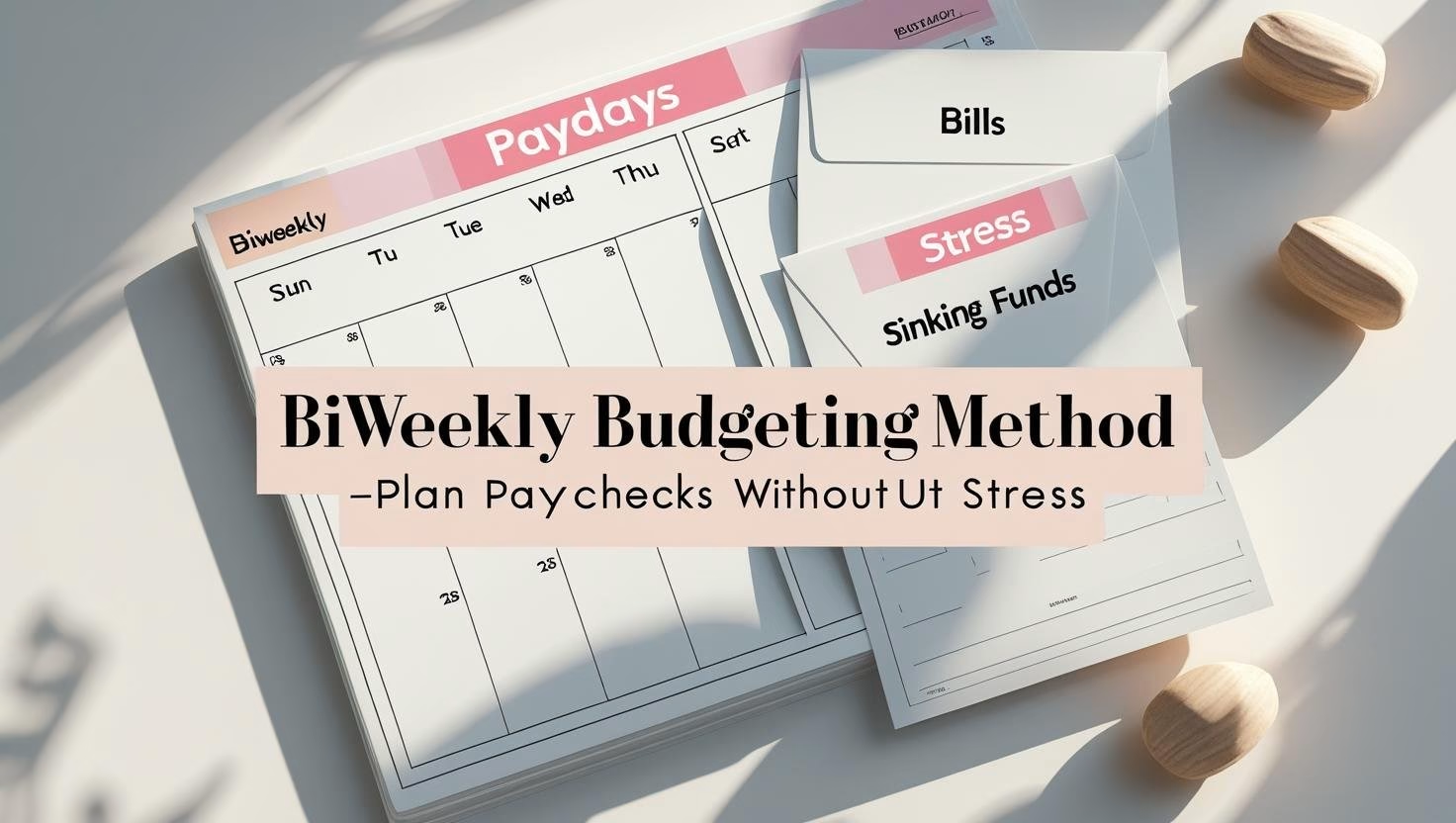
Most people who get paid every two weeks end up treating their finances like monthly budgeters — and that mismatch quietly causes overdrafts, missed savings goals, and a persistent sense that money just disappears. A biweekly budget works differently: instead of planning around a calendar month, you plan around each paycheck as it lands. That shift aligns your spending decisions with your actual cash flow, which is the single most effective thing a biweekly earner can do to stop living paycheck to paycheck.
Why Monthly Budgets Fail Biweekly Earners
The standard advice to budget monthly sounds reasonable until you do the math. If you earn $60,000 a year and divide that by 12, you get $5,000 per month to budget with. The problem: you're not receiving $5,000 on the first of every month. You're receiving roughly $2,308 every two weeks — 26 times a year.
That difference matters for two reasons. First, not every month has the same number of paychecks. Ten months of the year you receive two paychecks. Two months of the year you receive three. A rigid monthly budget built on "average" income ignores that variation entirely, which means your budget is wrong by a full paycheck in the months where the third one arrives — and wrong in the other direction in the ten months when you're working with exactly two.
Second, bills arrive on fixed calendar dates, not biweekly intervals. Rent is due on the first. Utilities cycle on the fifteenth. Car insurance drafts mid-month. When your income arrives on a biweekly schedule and your bills arrive on a monthly calendar, the gap between "money in" and "bill due" swings wildly. Some paychecks cover almost nothing. Others have to stretch across a long stretch before the next one arrives.
Monthly budgeting papers over these timing gaps with averages. Biweekly budgeting eliminates them by treating each paycheck as a discrete unit of planning.
Building Your biweekly budget: The Paycheck Assignment System

The foundational technique for biweekly budgeters is paycheck assignment: every bill, savings transfer, and spending category gets claimed by a specific paycheck before that paycheck arrives. Think of it as pre-allocating each dollar the moment you know when it's coming.
Here's how to set it up:
Step 1: List every recurring expense with its due date. Include rent or mortgage, utilities, internet, phone, subscriptions, insurance premiums, minimum debt payments, and any automatic transfers. Note the exact due date for each.
Step 2: Map due dates to paycheck dates. Take your next two paycheck dates and draw a simple two-column table. Assign each bill to whichever paycheck arrives closest before the due date — ideally at least two to three days before, to give the payment time to process.
Step 3: Calculate what's left for variable spending. After assigning all fixed bills to each paycheck, what remains is your variable spending budget for that two-week period. This covers groceries, gas, dining, entertainment, and anything unplanned.
Step 4: Assign savings last, not first. Once you see the real variable spending room per paycheck, set a realistic savings transfer amount for each one. Starting with savings first sounds disciplined but often leads to shortfalls when your variable spending estimate is off. Get accurate numbers first, then automate savings.
A practical split might look like this: Paycheck 1 (first of the month) covers rent, renter's insurance, and the car payment. Paycheck 2 (mid-month) covers utilities, streaming subscriptions, phone bill, and the gym membership. Both paychecks carry half the monthly grocery and gas estimate, plus equal savings transfers. Nothing is left to chance or memory.
Handling the Two Extra Paychecks Each Year
This is where biweekly budgeting becomes genuinely powerful — and where most people without a plan quietly lose ground.
Because a year has 52 weeks and paychecks arrive every two weeks, you receive 26 paychecks annually. Divided into pairs, that's 13 "paycheck pairs" — but a calendar year only has 12 months. The result: two months of the year contain three paychecks instead of two.
If your regular monthly expenses are already covered by your two standard paychecks, those third paychecks arrive with no pre-assigned obligations. Without a plan, they blend into regular spending and vanish. With a plan, each of those two extra paychecks — typically worth a full net paycheck for you — can do serious financial work.
Option A: Emergency fund. The standard recommendation for an emergency fund is three to six months of essential expenses. Two extra paychecks per year, consistently directed into a high-yield savings account, can build that cushion faster than any monthly savings plan that tries to claw back a small amount from already-stretched budget lines.
Option B: Accelerated debt payoff. If you carry a balance on credit cards or a personal loan, applying an entire extra paycheck directly to principal has an outsized impact. Because interest compounds on the outstanding balance, a single large principal payment early in the year reduces the interest you pay over the remaining months.
Option C: Investment contribution. For those with retirement accounts or taxable brokerage accounts, the extra paychecks represent a clean annual opportunity to make a lump contribution — especially useful for catching up to IRA limits before the tax year deadline.
The key is deciding in advance, before the month with the third paycheck arrives. Look at your paycheck schedule at the start of the year, identify which months will have three paycheck dates, and write down specifically what that third paycheck will do. An unplanned extra paycheck almost always becomes extra spending.
Syncing Bill Due Dates to Your Paycheck Calendar
Most people assume that bill due dates are fixed — they're not. Utility companies, credit card issuers, insurance providers, and many subscription services will change your billing date if you ask. This is one of the most underused tools in personal finance.
The goal is to cluster your bills so that each paycheck covers a clean batch, with no bill due date falling in an awkward gap after you've already committed that paycheck's dollars elsewhere.
To request a due date change, contact the billing department directly — by phone or through your online account. For credit cards, you're typically looking for a "change payment due date" option in account settings. Utility companies usually handle it by phone. Most will accommodate a one-time shift of up to two weeks without any paperwork.
A practical target: keep all bills assigned to Paycheck 1 due between the 1st and 5th of the month. All bills assigned to Paycheck 2 due between the 15th and 20th. This leaves a buffer between paycheck arrival and bill due date, and keeps the two paycheck "buckets" cleanly separated.
Once your due dates are aligned, the biweekly budget becomes far less manual. Instead of checking whether a bill is coming up, you know that Paycheck 1 pays for a fixed set of things and Paycheck 2 pays for a different fixed set. The variables — groceries, gas, discretionary spending — are the only categories that need active monitoring between paychecks.
Tools That Support Paycheck-by-Paycheck Budgeting

Two apps have earned genuine reputations among people who budget on a biweekly schedule.
YNAB (You Need A Budget) is built around a methodology called "give every dollar a job." When a paycheck arrives, you assign each dollar to a specific category before spending it. This maps naturally onto biweekly budgeting: rather than planning a month in advance and hoping the math works out, you assign the dollars you actually have right now. YNAB also handles irregular income well — if your take-home varies by pay period, you assign only what arrived, never what you expect.
Copilot is an AI-powered budgeting app that connects to your bank accounts and automatically categorizes spending as it happens. It's particularly useful in the early months of building a biweekly budget, when you're still figuring out what your actual variable spending looks like per two-week period. Copilot's weekly summaries make it easy to see If you're on pace to stay within each paycheck's allocated variable spending before the period ends.
For people who prefer a spreadsheet over an app, a simple template works well: two columns per month (one per paycheck), with rows for each assigned bill, the variable spending allocation, and the savings transfer. The advantage of a spreadsheet is transparency — you can see both paychecks for the month on the same screen and adjust assignments when something changes.
The Bureau of Labor Statistics Consumer Expenditure Survey data (bls.gov/cex) provides useful benchmarks for what households at different income levels spend across categories. If you're building your first biweekly budget and aren't sure how much to allocate for groceries, utilities, or transportation, the survey averages give you a starting reference point.
Common Mistakes That Derail Biweekly Budgets
Even with a solid framework, a few recurring patterns trip people up.
Averaging instead of assigning. The biggest mistake is calculating your "average biweekly income" and budgeting the same amount every two weeks. If your paycheck varies — bonuses, overtime, commission, hours worked — averaging introduces error. Budget what you actually receive each pay period, not what you expect to receive on average.
Ignoring annual and semi-annual bills. Car registration, professional memberships, annual software subscriptions, and semi-annual insurance premiums don't appear in most monthly budgets until they hit. In a biweekly budget, these need a dedicated line called a "sinking fund" — a small amount set aside from each paycheck so that when the annual bill arrives, the money is already sitting there. Divide the annual cost by 26 to find the per-paycheck contribution.
Not adjusting when pay dates shift. Holidays, banking closures, and payroll processing delays sometimes push paychecks by a day or two. If a paycheck arrives on a Friday instead of a Thursday, and a bill is due that same Friday, you may have a same-day processing gap. Build a two-to-three-day buffer between expected paycheck arrival and bill due dates to absorb these shifts.
Over-complicating the system in month one. A biweekly budget doesn't need to track every dollar in every subcategory. Start with four categories: fixed bills, variable necessities (groceries and gas), savings, and discretionary. Add granularity only after two or three months of data show you where the friction actually is.
Making the First Month Work
The first month of switching to a biweekly budget is always the hardest, because you're building the assignment system while also living inside the budget for the first time. A few things make the transition smoother.
Start on a Paycheck 1 date, not mid-cycle. Beginning the system at the start of a new pay period means you have a full two weeks of data from the first period, rather than trying to reconcile a partial period.
Give yourself a "cash float" category — a small buffer of $100 to $200 that you don't assign to anything specific in the first month. This absorbs timing errors, forgotten bills, and the inevitable expense that doesn't fit cleanly into your initial categories. Once you've run the system for a few months and your categories are dialed in, you can eliminate the float or redirect it to savings.
Track the first month's actual spending against your assignments every few days, not just at the end of the two-week period. Early course corrections are easier than trying to recover a blown budget in the final days before the next paycheck.
By month three, most biweekly budgeters report that the system feels entirely automatic. The assignment step at the start of each pay period takes fifteen minutes or less. The mid-period check-ins become quick glances rather than deep reviews. And the two extra paychecks per year become something to look forward to — planned opportunities with a clear destination, rather than unexpected cash that disappears without a trace and leaves nothing behind.
--- None of this is financial advice. Your situation depends on variables this article can't see — taxes, risk tolerance, time horizon, dependents. A fiduciary advisor can model your specific case.




No comments yet